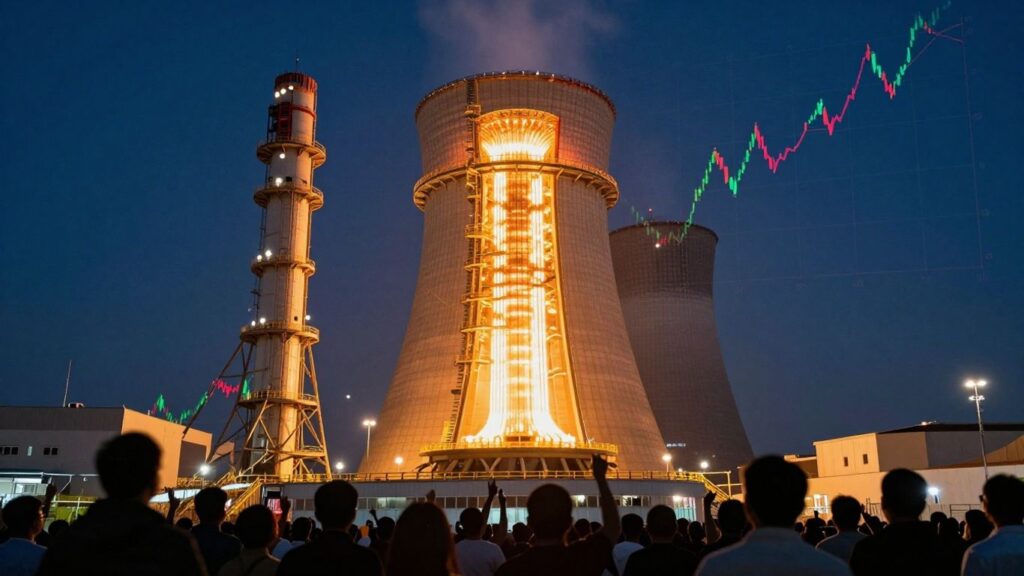

Nuclear fusion, the long-sought-after clean energy source powering the sun, is experiencing an unprecedented surge in investment, attracting billions of dollars. Recent scientific breakthroughs have transformed fusion from a distant dream into a tangible possibility, sparking a "gold rush" among startups and attracting major tech players and venture capital.
Key Takeaways
- Recent scientific advancements, including achieving net-positive energy in controlled reactions, have reignited interest in fusion.
- Fusion startups have collectively raised billions in private investment, with significant funding from tech giants and billionaires.
- The growing demand for clean, reliable energy, driven by AI and data centers, is a major catalyst for fusion investment.
- While challenges remain in commercialization and scaling, the outlook for fusion energy is more optimistic than ever.
The Dawn of a New Energy Era
For decades, nuclear fusion has been the elusive promise of endless, carbon-free energy. The process, which involves merging atomic nuclei to release vast amounts of energy, has historically been plagued by the challenge of consuming more energy than it produces. However, a controlled fusion reaction in 2022 that achieved net-positive energy marked a pivotal moment, turning this long-held aspiration into a potential reality.
A Surge in Investment and Innovation
This scientific breakthrough has triggered a significant influx of capital into the fusion sector. In 2025 alone, fusion startups raised an estimated $2.6 billion, according to the Fusion Industry Association. Major technology companies like Microsoft and Google, alongside billionaires Bill Gates and Jeff Bezos, and even oil giant Chevron, are investing heavily in various fusion energy companies. This widespread interest has led to a rapid increase in the number of fusion startups globally.
Driving Forces Behind the Fusion Boom
The renewed enthusiasm for fusion is fueled by several factors. The urgent need for clean energy solutions to combat climate change is paramount. Additionally, the exponential growth of artificial intelligence and data centers has created an unprecedented surge in electricity demand. Fusion offers a potential solution for a carbon-free, always-on energy source capable of meeting these escalating needs.
Key Players and Projects
Several companies are at the forefront of this fusion revolution. General Fusion, a B.C.-based company, aims to have its first fusion power plant generating electricity by 2035 and is pursuing a public listing. Commonwealth Fusion Systems (CFS) has emerged as a leading player, raising over $2 billion and planning to deliver power to customers in the early 2030s. On a larger scale, the multinational ITER project in France, though facing delays, is a significant undertaking aimed at demonstrating the feasibility of fusion power.
Overcoming the Hurdles
Despite the optimism, significant challenges remain. Creating and sustaining the extreme conditions required for fusion—temperatures of millions of degrees Celsius and immense pressure—is monumentally difficult. Maintaining plasma stability and achieving a high enough energy output ratio for commercial viability are ongoing areas of research. Furthermore, the cost-effectiveness of fusion power compared to other energy sources is still being determined.
The Future of Energy
While some experts caution that commercial fusion power plants may still be years away, the current momentum suggests a transformative shift is underway. Projections indicate the fusion energy sector could reach tens of billions of dollars by 2036 and hundreds of billions by 2050. The convergence of scientific advancements, substantial investment, and growing energy demands positions nuclear fusion as a critical component of the future clean energy economy.
Sources
- Fusion energy’s long shot has become a gold rush, Corporate Knights.
- Nuclear fusion seems hot right now — but how close is fusion power?, CBC.
- A Nuclear Fusion Breakthrough May Be Closer Than You Think, Time Magazine.
- Nuclear fusion: The science behind the energy technology, The World Economic Forum.
- Nuclear fusion: The science behind the energy technology, The World Economic Forum.