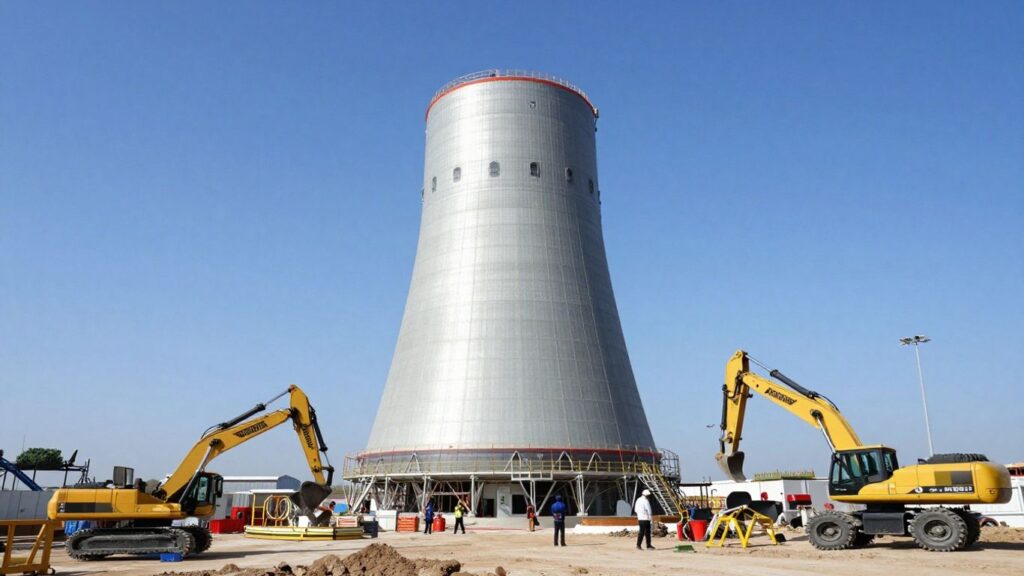

Major technology companies are making significant investments in nuclear energy to meet the escalating power demands of their data centers and the burgeoning field of artificial intelligence. This strategic shift aims to secure a consistent, carbon-free energy supply, though challenges related to public perception, cost, and technological timelines remain.
Key Takeaways
- Meta has announced deals with nuclear energy companies Vistra, Oklo, and TerraPower to secure power for its data centers.
- These agreements aim to add substantial power capacity by 2035, supporting AI development.
- Other tech giants like Google and Amazon are also exploring nuclear energy solutions, particularly Small Modular Reactors (SMRs).
- The surge in demand for AI is driving unprecedented investment in power generation, with data centers consuming vast amounts of electricity.
The AI Energy Demand
The rapid advancement of artificial intelligence has created an immense appetite for electricity. Data centers, the backbone of AI operations, are consuming power at an unprecedented rate. Projections indicate that data center energy consumption could double in the next five years, posing a significant challenge for existing power grids and the pursuit of clean energy goals. This has led tech giants to seek reliable, always-on, and carbon-free energy sources, with nuclear power emerging as a prime candidate.
Big Tech’s Nuclear Investments
Companies like Meta, Microsoft, Google, and Amazon are actively pursuing nuclear energy solutions. Meta has entered into agreements with Vistra Corp. for power from existing reactors and with startups Oklo and TerraPower for future power from their developing reactors. Microsoft has also made a substantial investment to revive the Three Mile Island nuclear plant for its data centers and has joined the World Nuclear Association. Google is exploring power purchase agreements from planned nuclear fusion plants.
Small Modular Reactors (SMRs) and Challenges
Many tech companies are focusing on Small Modular Reactors (SMRs), a newer technology that promises lower construction costs and theoretically reduced safety risks due to cooler operating temperatures. However, SMRs are largely still in the developmental or testing phases, with commercial viability estimated to be years away. Experts caution that SMRs may not be able to meet the immediate, supercharged energy demands of AI in the next one to two years. Furthermore, concerns persist regarding public perception, the long-term storage of radioactive waste, and the economic feasibility of smaller-scale reactors compared to traditional, large-scale plants.
The Broader Energy Landscape
While nuclear energy offers a potential solution, it is part of a larger energy transition that requires diverse approaches. Energy companies in the US are investing record amounts in power plants to meet data center demand. Experts also emphasize the need for localized strategies in the energy transition, acknowledging that different regions face unique challenges and priorities. Simultaneously, research is ongoing to develop more energy-efficient AI models and hardware, aiming to reduce the overall power consumption of AI technologies.
Stock Market Reactions
The increased interest and investment in nuclear energy by Big Tech have led to a surge in the stock prices of several nuclear energy companies. Stocks such as Constellation Energy, Vistra Corp., Mirion Technologies, BWX Technologies, and Cameco Corp. have seen significant gains, reflecting investor confidence in the sector’s growth potential driven by AI-related power demands.
Sources
- Why big tech’s nuclear plans could blow up, BBC.
- These Nuclear Energy Stocks Are Soaring Thanks to Deals With Meta, Investopedia.
- US energy firms spend big on data centre power – and more top energy stories, The World Economic Forum.
- Watch 5 Nuclear Energy Stocks Set to Surge on Huge Data Center Growth, Yahoo Finance.